Hazardous Tree Removal Toronto: 12 Warning Signs Your Tree Needs an Arborist
If you are looking for hazardous tree removal Toronto homeowners and property managers can rely on, the first step is not automatically cutting a tree down. It is understanding whether a visible defect creates a meaningful risk, how soon action may be needed, and whether pruning or another treatment can manage it. A tree can look concerning without being an immediate danger, while a subtle defect can matter greatly when it is above a roof, walkway, parking area, or work zone.
What are the warning signs a tree may be hazardous?
A tree may need prompt assessment when it has a new lean, lifted soil, major dead limbs, fresh trunk cracks or storm damage above places people use. These signs do not prove removal is necessary; an arborist evaluates the whole tree, its setting and possible management options.
Key takeaways
- Dead limbs, fresh cracks, root-plate movement, new leaning, major storm damage, or a defect over a target deserve prompt professional attention.
- A warning sign is a reason to assess the whole tree, not a diagnosis or automatic instruction to remove it.
- An ISA-certified arborist can explain the observed conditions, likely consequences, urgency, and whether pruning, monitoring, protection, or removal is appropriate.
- For a tree that has fallen, is actively splitting, or threatens immediate injury, keep people away and request emergency help.
- Toronto tree by-laws may apply. Confirm current permit and emergency requirements directly with the City before work begins.
Concerned about a tree on your property? Request a free quote from Bosco Tree.
How to read warning signs before deciding on removal
Tree risk is not determined by one photograph or one symptom. A professional considers the tree’s condition, structure, surroundings, and the people or property that could be affected if a part failed. A branch over a rarely used garden bed does not present the same exposure as one above a busy entrance. The tree’s species, growth pattern, recent changes, prior pruning, soil conditions, and weather history also matter. A visual warning should guide a careful assessment, not replace one.
Walk around the tree only if it is safe to do so. Do not stand beneath a hanging limb, touch a split trunk, enter an area under a leaning tree, or approach a downed tree entangled with electrical lines. Note what changed and when, take pictures from a safe distance, and share the location and situation with a qualified professional. Bosco Tree provides arborist reports in Toronto as well as tree care and removal services. Learn more about the company’s arborist experience and approach before requesting a site assessment. Browse the Bosco Tree website for an overview of its work, or view the full tree care services menu.
Checklist: visible signs that call for a tree assessment
- New or worsening lean. A recent change, especially with lifted soil, calls for prompt professional review.
- Fresh crack or split. Keep clear of a trunk or union that appears newly separated or is changing.
- Dead or hanging limb. A large limb above a roof, entrance or walkway should not be pulled down by hand.
- Root-plate movement. Raised or cracked soil near the base may indicate movement below ground.
- Repeated branch failure. Several breaks in one area can signal a structural issue that needs context.
- Defect above a target. A defect matters in relation to the people, buildings and paths that could be affected.
12 warning signs that may call for hazardous tree removal in Toronto
1. Large dead branches or a dead crown
Dead branches can break without warning, especially when they are large, poorly attached, or suspended above an area people use. Look for limbs with no leaves during the growing season when neighbouring branches are leafed out, brittle twigs, bark loss, and branches that have recently dropped. A declining or dead crown may indicate a serious health issue, but the extent and cause need to be assessed. Sometimes only selected limbs need to be removed; in other cases, extensive decline, structural weakness, or the tree’s position can support full removal.
Do not try to pull down a hanging branch with a rope, pole, or vehicle. It may be under tension, may break unpredictably, or may be connected to other limbs. A trained crew can determine how to access and dismantle the branch safely. If the concern is chiefly deadwood over the house, ask whether targeted tree pruning and trimming can reduce the hazard while preserving a sound tree. For a tree that is dead throughout or unsafe to retain, a professional can explain the case for tree removal in Toronto.
2. Cracks, splits, or a separating union
Vertical cracks in a trunk, a split extending from a branch union, or two stems pulling apart can signal that the wood is no longer holding together as expected. Fresh, widening, or deep cracks deserve prompt attention, particularly when the affected stem is large or positioned above a home, driveway, sidewalk, or neighbouring property. A crack can also be old and stable, or limited to outer bark. The visible line alone cannot tell you the remaining strength.
Look for related clues without touching the defect: a branch or stem that has shifted, exposed wood, a seam that opens under wind, or a crack accompanied by new movement. A structural assessment should consider how the stems connect, the tree’s balance, and the consequences of failure. Avoid parking or gathering beneath the affected part until it has been reviewed. Depending on the findings, the arborist may recommend a specific limb reduction or removal, continued observation, or removal of the whole tree. Where cutting is recommended, the crew should explain how the work will be carried out and what the site will look like afterward.
3. Fungal growth, mushrooms, or conks
Mushrooms at the base of a tree, shelf-like conks on the trunk, or fungal growth near a major root can be a clue that decay is present. Fungi feed on organic material, and some species are associated with decay in wood. Their presence does not, by itself, establish how extensive the decay is or prove that a tree will fail. A small growth may be on a root or old wood, while decay inside a trunk can be difficult to see from outside.
Record where the growth appears and whether it is new or recurring, but do not remove it before an assessment; its location and form can help an arborist understand the situation. Also note dead branches, cavities, root damage, or a change in the tree’s lean. An arborist can inspect the base, trunk, roots, and crown, then advise whether further evaluation or management is appropriate. Do not rely on a do-it-yourself test such as striking, drilling, or digging around the base. Such actions can cause injury and may damage the tree or hide useful evidence.
4. A new or worsening lean
Some trees grow at an angle and remain stable for years. A lean that has recently appeared or increased is different: it may reflect root failure, soil movement, a broken stem, or disturbance from construction or weather. A new lean is especially concerning when the ground around the trunk is raised or cracked, roots are exposed, or the tree is moving in wind. Photograph it from a safe location and compare the image with older photos if available; do not approach the root zone to investigate.
Consider what lies in the tree’s potential fall area, but do not try to calculate a safe zone yourself. Keep people, pets, and vehicles away, and seek prompt professional advice. If the tree is actively shifting or threatens immediate harm, treat the situation as an emergency and call for help from a safe location. The right response may be temporary access restrictions, removal of a compromised portion, or complete removal. The arborist should explain what evidence supports the recommendation rather than treating every leaning tree as a guaranteed failure.
Homeowners across the region can also find service information for Mississauga tree removal, Brampton tree removal, and Vaughan tree removal. If a tree sits near a property line, identify ownership and notify affected neighbours before non-emergency work is planned.
5. Root lifting, heaving soil, or exposed roots
Raised soil beside the trunk, a newly visible gap under the root plate, or roots that appear lifted can indicate movement below ground. These changes are more concerning when they appear suddenly, follow heavy wind or saturated ground, or occur with a new lean. Roots can also be exposed through ordinary erosion, grading, or landscape work, so the visible condition needs context. Do not dig around the base to see how far the roots extend. Keep clear of any area where the tree appears to be moving and request a professional assessment.
Root problems are not always visible. Construction, soil compaction, trenching, or grade changes can impair roots without producing an immediate canopy symptom. If work has recently occurred nearby, tell the arborist what was done and when. An assessment may consider the trunk base, soil, root exposure, canopy condition, nearby excavation, drainage, and the direction of lean. The recommendation may be to protect the tree from further disturbance, monitor it, prune selected limbs, or remove it if the risk cannot be managed appropriately.
6. Cavities, hollow areas, or missing bark
A cavity can form where a branch broke, where bark has died, or where decay has developed. A cavity is not automatically proof that a tree is unsafe: trees can compartmentalize injuries, and some hollow trees remain standing. What matters is how much sound wood remains, where the cavity sits, whether it connects to other defects, and what targets are nearby. Large openings, soft or crumbling wood, a cavity at the trunk base, or a hollow area near a major union should be examined rather than patched or filled.
Do not insert tools into an opening or attempt to seal it with concrete, foam, or household material. Such fixes can complicate assessment and do not restore structural strength. An arborist can inspect the defect and decide whether further diagnostic methods are warranted. Depending on the findings, selective pruning, a change in site use, follow-up monitoring, or removal may be discussed. Share any known history of limb failure or previous work, because the history can help interpret what is visible now.
7. Storm damage, hanging limbs, or a fresh break
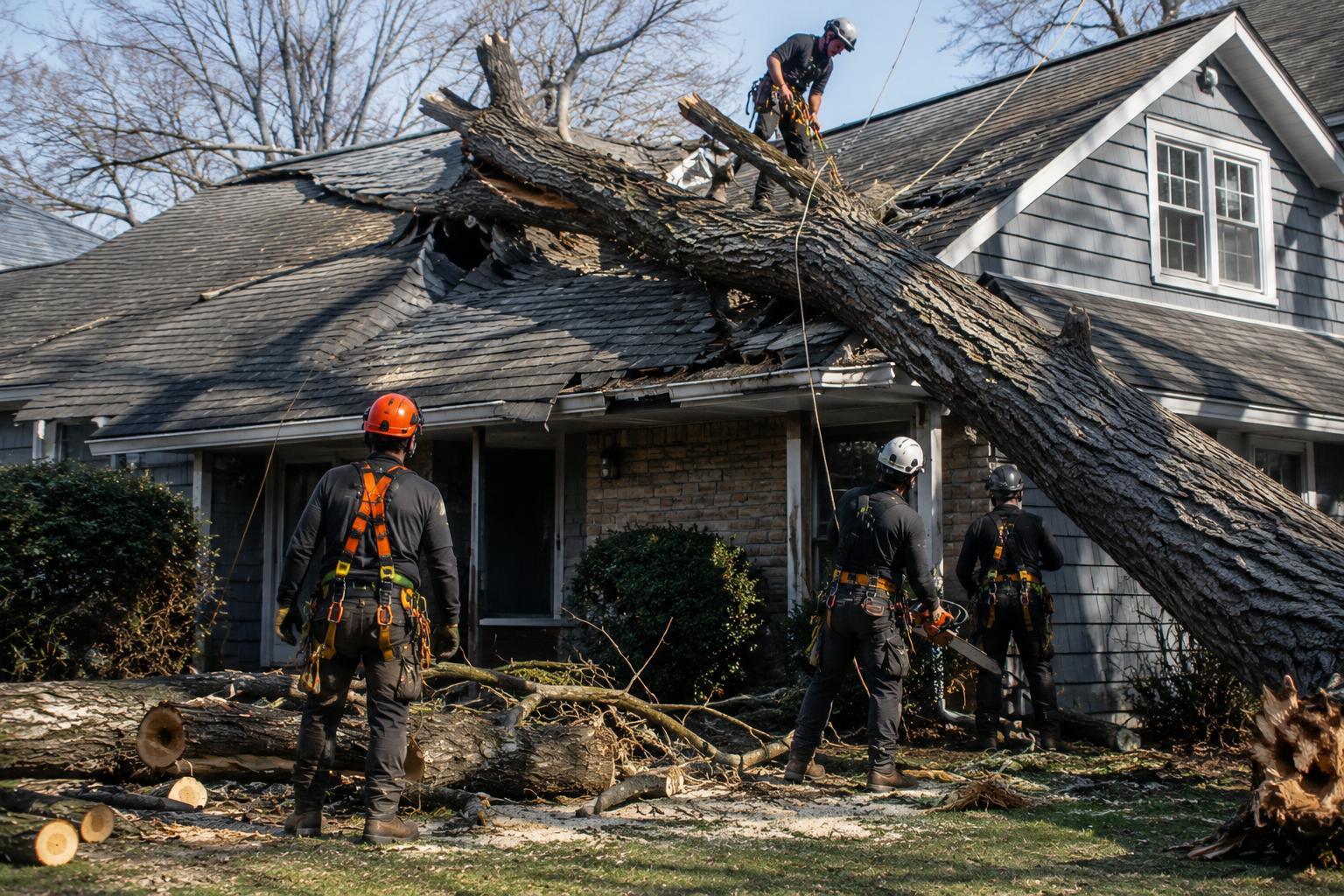
After a storm, inspect from a safe distance for broken tops, suspended limbs, split branches, fresh wounds, and newly shifted stems. Storm-damaged limbs may remain caught in the crown and fall later. A branch resting on another branch is not necessarily stable. Stay out from beneath it, keep people away, and do not attempt to use a ladder or chainsaw. If the tree or branch is near electrical wires, treat the wires as live and contact the appropriate utility or emergency authority; never approach or touch the tree.
Not every storm-damaged tree must be removed. A qualified arborist can assess whether the damage is limited to a limb, whether remaining parts can be maintained safely, and whether the tree’s structure has changed. The City’s storm guidance distinguishes between damage that can be maintained and significant damage where safe maintenance is not possible; ownership and applicable protections also affect the next step. For urgent conditions, Bosco Tree provides 24/7 emergency tree service in Toronto. You can also read the company’s guide to storm-damaged tree removal.
8. A tree close to a building, walkway, or utility line
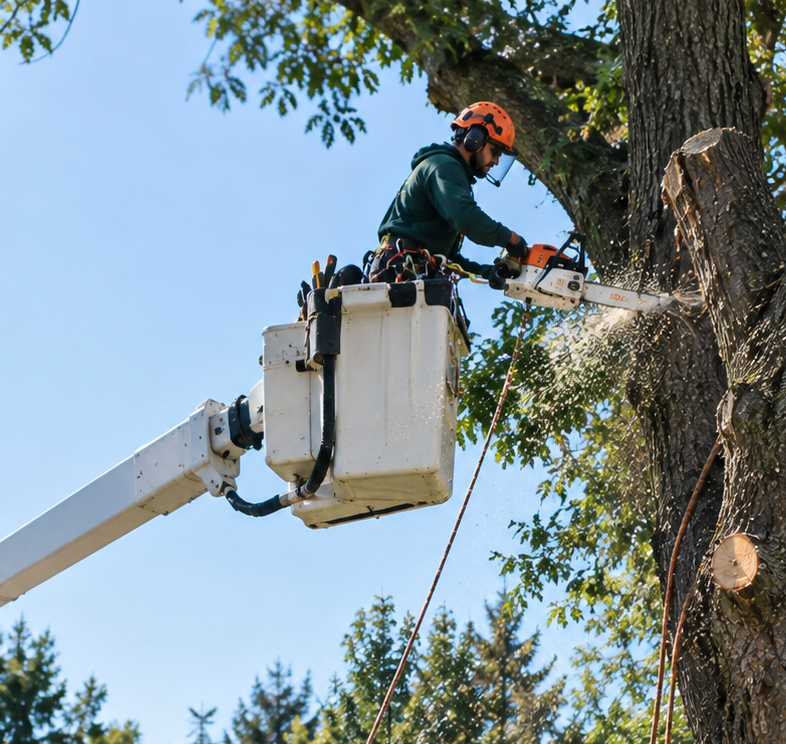
Location does not make a tree defective, but it changes the consequences if a branch or trunk fails. A tree over a house, occupied deck, parking area, school access, sidewalk, or neighbour’s property deserves context-specific review when a structural warning is present. A tree near electrical wires raises a separate safety issue: only the appropriate utility personnel should work around energized conductors. Do not prune branches near lines yourself or ask an unqualified crew to do so.
Tell the arborist which areas are used, when they are occupied, and whether the potential target can be temporarily closed. In some cases, a targeted reduction or removal of deadwood can lower exposure without removing the whole tree. In others, defects at the trunk or roots, or an inability to control the consequences of failure, may support removal. If a removal is recommended, discuss access, overhead hazards, adjacent structures, debris handling, stump options, and how the crew will protect the property. If the stump is also a concern, compare stump grinding and removal options.
9. A sudden change in the canopy
Rapid thinning, sections that fail to leaf out, widespread dieback, or an uneven crown can point to stress, root loss, disease, pests, or other changes. The cause may be treatable, or the decline may be advanced. A canopy change is more informative when compared with the tree’s earlier condition and the same season in prior years. Note whether one side is affected, whether the change began after excavation or drought, and whether twigs or branches are dying back from the tips.
Do not assume that every sparse tree is hazardous or that a green canopy guarantees sound structure. A health concern and a structural concern overlap, but they are not identical. The arborist should look at the crown, trunk, root zone, and site history, and explain what can be observed versus what remains uncertain. If the issue is a particular branch or clearance conflict, professional tree pruning in North York or a broader pruning plan may be more appropriate than removal.
10. Repeated limb failures or weak attachments
Several failed branches, included bark at a union, or a history of splitting in one part of the crown can suggest a recurring structural issue. A previous break can leave a wound that is more susceptible to further decay, and a weakly attached stem may carry substantial weight. A professional should assess the attachment, the direction of growth, the size and position of the affected limb, and whether pruning can reduce leverage without over-pruning the tree.
Keep a record of prior incidents and share it during the visit. Repeated breakage over a patio, entrance, or parking space may call for a stronger management response than an isolated small branch in a low-use area. The goal is not to remove as much canopy as possible. Good pruning is selective, suited to the tree, and carried out with a clear purpose. Learn about the best time to trim trees in Toronto and why timing should be considered alongside the immediate risk.
11. Root-zone or trunk injury from construction or vehicles
Scraped bark, a cut root, a damaged trunk, fresh soil changes, and repeated vehicle traffic close to a tree can compromise its condition. Damage may not create an immediate lean or branch symptom, so timing and documentation matter. Record what happened, preserve site photos, and avoid more disturbance. Tell the arborist about the equipment, excavation, or grade work involved. For construction near retained trees, a separate Toronto tree protection zone guide explains why the protection boundary and site practices matter.
In Toronto, the City’s Tree Protection Policy and Specifications and relevant by-laws may apply to construction near protected trees. Confirm the rules for your site with the City. If a tree is protected, an injury can raise compliance questions as well as arboricultural ones. Do not hide damage by covering it with soil or changing the site again; seek professional guidance and follow any City direction.
12. Multiple warning signs occurring together
Several defects in one tree can compound concern. For example, a new lean with lifted soil and a fresh crack near the base warrants more urgency than a minor old wound alone. A dead crown combined with a cavity and repeated limb failure may affect the options available. Still, a collection of symptoms does not let a homeowner determine a failure probability. The whole tree and its setting must be reviewed by someone qualified to assess tree structure and risk.
When contacting a tree company, describe the observable facts rather than making a diagnosis: “the trunk has a new split,” “the ground lifted after the storm,” or “a large limb is hanging above the entrance.” Share clear photos only if you can take them safely. Mention whether the tree is moving, whether a limb has fallen, whether lines are involved, and whether people can be kept clear. That information helps the team understand whether the request is routine, urgent, or an active emergency.
Hazardous tree removal Toronto: choosing the right response
A homeowner searching “hazardous tree removal Toronto” should expect an evidence-based assessment, not an automatic recommendation to cut. People comparing hazardous tree removal Toronto services should look for a clear explanation of the observed issue, options, and limits. The right scope depends on the tree, the site, the people or property exposed, and any City approval that applies.
What a professional hazard assessment should cover
A useful assessment is more than a quick glance at the trunk. The arborist should identify the tree and site context, inspect the crown and main unions, look for defects in the trunk and base, consider visible roots and soil conditions, and ask about recent events or previous failures. The discussion should include what could be affected if a limb or tree failed and whether access can be restricted while a longer-term decision is made.
The assessment should distinguish observed facts from interpretation. A crack, cavity, or fungus is a visible fact; its structural meaning requires analysis. The arborist should explain the concern in understandable terms, discuss reasonable management options, and describe any limits in the assessment. Recommendations might include pruning, removal of a particular stem, monitoring, temporary exclusion of an area, or removal of the tree. If a written opinion is needed for a property, project, or decision, ask about a formal arborist report and what it will address.
For clients who want to compare providers, our guide to choosing a Toronto tree service offers questions to ask about qualifications, insurance, work scope, and site protection. Bosco Tree’s crews serve Toronto and surrounding communities, including Markham and Richmond Hill.
Get a clear recommendation before the risk worsens. Bosco Tree offers free quotes and professional tree assessments.
Warning sign and sensible next step
| Observed sign | What it may indicate | Practical next step |
|---|---|---|
| New lean with soil movement | Possible root or soil disturbance | Keep clear and request prompt assessment |
| Large dead or hanging limb | Potential branch-failure concern | Avoid the drop zone; ask about selective pruning |
| Fresh trunk or union crack | Possible structural change | Do not touch; describe location and recent change |
| Fungal growth or cavity | Possible decay, extent uncertain | Record location; have the whole tree inspected |
| Damage above a busy target | Higher consequence if a part fails | Restrict access if safe and discuss management options |
When pruning may be enough—and when removal is more responsible
Pruning may be considered when the principal concern is limited to one or more branches and the trunk, roots, and remaining crown can be retained responsibly. It may address deadwood, clearance, a damaged limb, or weight distribution when the tree’s structure allows it. Pruning is not a cure for every defect, and removing too much canopy can create additional stress or leave an unbalanced structure. Ask what the proposed cuts are intended to accomplish and whether they preserve the tree’s natural form and health.
Removal may be appropriate when a tree is dead or declining beyond reasonable retention, has a serious structural defect that cannot be managed effectively, has sustained severe storm damage, or conflicts with a safety need in a way that cannot be resolved by less extensive work. A qualified arborist should explain the evidence behind that recommendation and whether there are alternatives. Removal is a significant decision, especially for a mature tree, so ask for a clear scope and confirm whether permits or other approvals are needed.
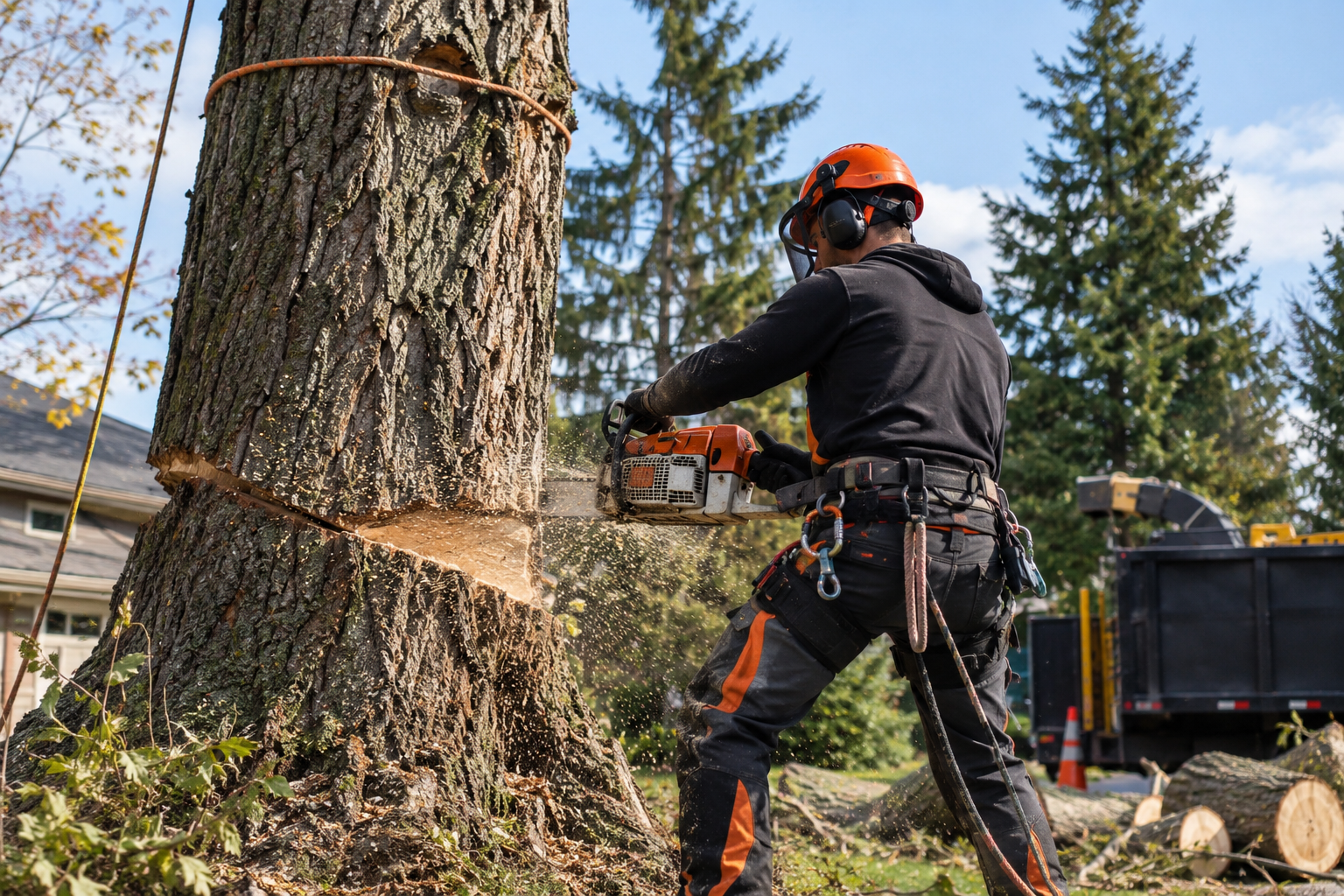
If removal is selected, logistics matter. The crew may need to dismantle the tree in sections to avoid buildings, fences, gardens, and nearby trees. Ask whether the quote covers stump grinding, debris removal, access preparation, and site cleanup. If you are planning a broader redevelopment, separate the hazard decision from the construction plan and consult the City about tree-protection obligations. Read our related explanations of what influences tree removal scope and stump grinding versus stump removal; neither replaces a property-specific quote.
Urgency: routine concern, prompt review, or emergency
A routine concern is a visible issue without signs of active movement or immediate exposure. Book an assessment and avoid making changes until you understand the condition. A prompt review is warranted for a new lean, lifted soil, fresh major crack, large hanging limb, recent trunk failure, or a substantial defect above a frequently used area. In the meantime, close the affected area if safe and practical, and do not attempt repairs yourself.
An emergency involves an active or imminent threat: a tree or major part has fallen, is shifting, is splitting, blocks a route, or is near live electrical wires. Move people away first. Do not approach the tree or wires; call emergency services or the utility when appropriate, then contact a qualified emergency tree service from a safe location. Bosco Tree provides 24/7 emergency response. The City of Toronto also provides procedures for certain City-owned tree hazards and storm damage; check the City’s current guidance to determine which authority to contact.
Whether a situation is urgent does not automatically determine the legal permit status. The Toronto Municipal Code contains specific provisions and exceptions, and the City’s permit information should be checked for the current situation. Before non-emergency removal, confirm whether the tree is protected and what approval is required. If the tree appears imminently hazardous, do not rely on a blog post as legal advice; contact the City and obtain direction. See the City’s Municipal Code Chapter 813 and its page on applying for a tree or ravine permit.
Toronto private tree by-law awareness
Toronto’s Municipal Code Chapter 813 includes rules for trees on City streets and private property. The City’s published permit information states that a permit is required before injuring or removing a protected tree, and its current application guidance describes the relevant protected-tree categories. The Code also includes exceptions, including provisions concerning terminally diseased, dead, or imminently hazardous trees certified in the manner specified by the Code. Because the legal test, documentation, tree status, and applicable provisions are specific, do not conclude that a tree can be removed without a permit based only on a visual sign or this article.
The phrase “hazardous tree removal Toronto” describes a search, not a diagnosis; the recommendation should come from an assessment of the tree and site. Identify whether the tree is private or City-owned, whether it may fall within a ravine or natural feature area, and whether recent City amendments affect the situation. Contact the City of Toronto to confirm the current requirement before arranging non-emergency work. If a tree poses immediate danger, protect people first and seek direction promptly. An arborist can help document conditions, but the City determines permit requirements and the applicable process. For a separate permit overview, visit Bosco Tree’s Toronto tree-removal permit guide.
When you need a second opinion, Bosco Tree’s ISA-certified arborists can assess the tree and explain the options in plain language. The company is based in Toronto, serves the GTA, has 18 years of experience, is fully insured with $2 million liability coverage, and offers free quotes. Read about ash tree removal considerations or tree removal in Mississauga for other local service needs.
Questions to ask before hiring for hazardous tree work
- Who will assess the tree, and what qualifications do they hold?
- What specific defect or site condition is driving the recommendation?
- Can pruning or another management option address the concern, and what are its limits?
- Does the scope include equipment access, protection of nearby property, debris cleanup, and stump work?
- Who will confirm the required City permits or approvals before non-emergency work?
- How will the crew manage overhead hazards and keep people clear during the work?
A good quote should make the work understandable. It should identify the tree, state whether the proposal is pruning or removal, describe what happens to the wood and branches, and clarify exclusions. When comparing hazardous tree removal Toronto providers, look for a clear scope, an explanation of the observed concern, and confirmation of who will check City requirements. For a removal, ask whether the stump remains and whether cleanup is included. For pruning, ask which limbs are included and what outcome the work is designed to achieve. Confirm that the contractor is insured and that the proposed plan accounts for nearby structures and site access.
Tree work can involve complex rigging, elevated work, heavy equipment, and changing loads. Do not select a contractor solely because they promise to remove a tree quickly. A professional company should be willing to discuss the site-specific risks, explain the planned sequence, and answer reasonable questions. Bosco Tree’s stated service area covers Toronto and the GTA, including Brampton and Vaughan, with a free quote available for planned work.
How to prepare for a tree hazard assessment
- Stay outside the danger area. Keep people and pets away from hanging limbs, a moving tree and any wires.
- Record what changed. Note when you first saw the lean, crack, break or canopy change.
- Take safe photographs. Use a distant view; do not climb, touch the tree or enter a drop zone.
- Identify nearby targets. Tell the arborist about buildings, walkways, driveways and areas people occupy.
- Share relevant history. Mention storms, excavation, prior failures or work around the roots.
- Ask for options and limits. Request an explanation of observed defects, urgency, management options and any uncertainty.
How to prepare for an arborist visit
Before the appointment, note the tree’s location and the visible change that prompted your call. If possible, gather older photos, information about past pruning, and details of recent storms, digging, grading, or building work. Make a list of nearby targets such as a roof, utility line, walkway, driveway, or neighbouring yard. Do not climb the tree or move debris that may be unstable simply to obtain a better picture.
Make access safe for the assessment. Keep children and pets away from the affected area, unlock gates if appropriate, and tell the arborist about any electrical wires, restricted access, or hazards on the property. If you are a tenant or property manager, confirm who has authority to approve work. For shared or boundary trees, communicate with the relevant owner before scheduling non-emergency work. The professional can then inspect what is accessible and explain if a written report, City consultation, or follow-up visit is warranted.
If the tree is part of a construction project, give the arborist drawings or a description of planned work. That makes it easier to assess whether excavation or equipment routes could affect roots and whether protection is needed. A hazard assessment and a TPZ plan answer different questions, but both can be relevant on a development site. Keep the recommendations, photos, correspondence, and any approvals together so contractors can follow the agreed plan.
Related tree care across the GTA
Hazards and service needs vary by property. Bosco Tree offers tree removal in Markham, tree removal in Richmond Hill, and tree removal in Vaughan, as well as pruning, stump grinding, lot clearing, arborist reports, and emergency service. If you are researching a different stage of tree care, see Toronto tree trimming, stump grinding, or GTA lot clearing.
The best next step is the one that fits the actual condition: arrange a non-urgent inspection, restrict access and request prompt advice, or treat an active threat as an emergency. For hazardous tree removal Toronto homeowners should prioritize a qualified assessment, safe work planning, and permit confirmation over a quick yes-or-no decision. A professional assessment should leave you knowing what was observed, what it may mean, what the options are, and what should happen next. That clarity is more useful than a blanket promise that every tree with one visible defect must be removed.
For additional background, browse Bosco Tree’s guide to tree protection zones near construction and its explanation of arborists versus tree service providers. This article provides general information, not an individual diagnosis or legal opinion. City requirements can change; confirm current requirements directly with the City of Toronto before undertaking work that may be regulated.
When to call a professional about this tree issue
Call an arborist for a new lean, lifted soil, fresh major crack or large hanging limb, especially above a frequently used area. If a tree is actively shifting, splitting or near live wires, move away and contact emergency services or the utility as appropriate. For an assessment, review Toronto tree-removal service options and request a free quote.
Frequently asked questions about hazardous tree signs in Toronto
What are the clearest signs a tree may be hazardous?
New leaning, lifted soil, large dead or hanging branches, fresh trunk cracks and major storm damage merit professional review, especially over places people use. No single sign proves removal is necessary; an arborist evaluates the tree, defects and surrounding targets.
Does a leaning tree always need to be removed?
No. Some trees have a long-standing stable lean. A new or worsening lean, particularly with soil movement, exposed roots or a fresh crack, needs prompt assessment. A professional considers structure, site conditions and possible targets before recommending management.
Can a tree with mushrooms or fungus be saved?
Sometimes. Fungal growth can be associated with decay, but its presence alone does not establish how extensive decay is or whether the tree is unsafe. Record where it appears, do not probe or remove it, and ask an arborist to assess the whole tree.
When should I call emergency tree service?
Call for urgent help when a tree or major limb has fallen, is actively shifting or splitting, blocks access, or threatens immediate injury. Keep clear of the tree and any wires. Contact emergency services or the utility when appropriate, then request qualified tree help from safety.
Is a permit required to remove a hazardous private tree in Toronto?
Permit requirements depend on tree status, location and current rules. Toronto guidance describes a limited imminent-hazard exception with specified professional certification; a visual concern alone does not establish eligibility. Confirm the current requirement with the City before non-emergency work.
Is pruning safer than removing a hazardous tree?
It depends on the defect and what can safely remain. Selective pruning may address a limited branch problem, while serious trunk, root or whole-tree defects may call for removal. Ask the arborist to explain the evidence, alternatives and limits of the recommendation.
What happens during a tree hazard assessment?
An arborist reviews the crown, unions, trunk, base, visible roots, site conditions and targets that could be affected. They may ask about storms, prior failures and nearby work, then explain observed defects and possible management options. A photo alone cannot settle the decision.
Should I move a fallen branch or inspect a damaged tree myself?
No, not if the branch may be suspended, under tension, unstable or near electrical wires. Keep people away and let qualified responders assess the hazard. Photograph only from a safe place; never climb, pull a limb or use tools to test the tree.

Tree Removal Near Power Lines Toronto | Bosco Tree
Learn who to call about a tree near Toronto power lines, how the utility determines trimming responsibility, and what to confirm before tree work.
Storm Damaged Tree Removal Toronto: What to Do and Who to Call
Learn what to do after storm tree damage in Toronto, how to protect people, document damage, choose emergency help and plan stump follow-up.