Tree Removal Ravine Property Toronto: Rules, Permits and Safe Work
Tree removal on a ravine property in Toronto requires more than choosing a tree service and booking a crew. First, you need to understand whether the property is inside a protected ravine or natural feature area, which rules apply to the tree and the surrounding ground, and whether the City must authorize the work before anyone begins. A steep slope, narrow access or tree near a home can also change how a safe removal is planned. This guide explains the practical questions to resolve before hiring a crew for tree removal ravine property Toronto homeowners may be considering.
- Check the City’s ravine-protection map for the exact property; a ravine-adjacent address alone does not establish whether the lot is regulated.
- In a protected area, the City says removal or injury of trees of any size, grade changes, and placing fill or refuse are controlled unless authorized.
- Outside protected areas, Chapter 813 generally protects private trees at least 30 cm in diameter; City street trees are protected at any size.
- Permits and arborist documents must be confirmed before work; an application is not a permit and does not guarantee approval.
- On slopes, careful access, soil protection and debris control belong in the work plan, not as afterthoughts.
Do Toronto ravine properties need a permit for tree removal?
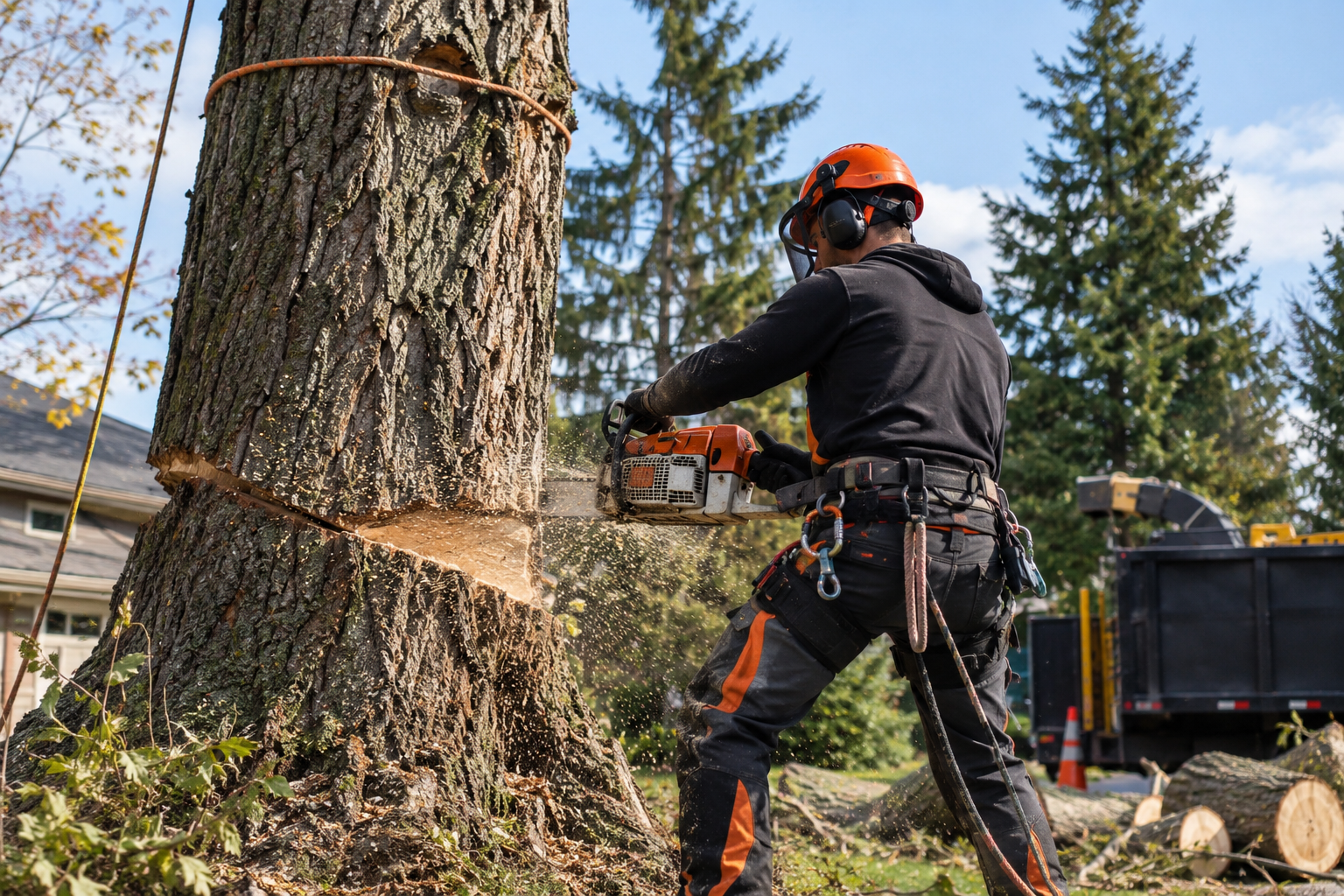
A permit is required before a tree is injured or removed, fill or refuse is placed, or land grade is changed within Toronto’s Ravine and Natural Feature Protection area. Tree size does not remove that requirement. An address beside a ravine alone is not enough; confirm the mapped boundary and proposed work with the City.
A tree on a level front lawn may have straightforward access, but a ravine property can have several constraints at once: a steep grade, limited space for equipment, a narrow route through a side yard, nearby trees that must remain, or a drop below the work area. The slope may also be part of a protected natural feature. The removal plan therefore has to consider not only how to take down the tree, but how to reach it, control each section as it comes down, keep equipment and material out of sensitive areas, and leave the ground stable and orderly.
That difference starts with the site, not the chainsaw. A crew needs a clear understanding of the tree’s position relative to the house, fences, neighbouring lots, access paths, the top of the bank and the ravine line shown on official records. A tree that looks like it stands in a private rear garden may be close to a regulated area, or its roots and working space may extend into one. Property boundaries and tree ownership also matter. Do not assume that the person who can see or reach a tree has the right to authorize its removal.
For a professional assessment, share photographs from more than one angle and explain the access route, grade, nearby structures and any recent ground disturbance. An on-site visit can help an arborist identify where the tree can be worked from, what needs protection and whether the proposed method is feasible. Bosco Tree provides tree removal in Toronto and arborist reports; a site-specific evaluation is the starting point for discussing a difficult ravine job. Learn more about the company’s arborist experience or begin with the tree care services overview.
Toronto’s ravine rules and private tree by-law
Two municipal rules may be relevant, and they do not protect exactly the same things. Toronto’s Ravine and Natural Feature Protection By-law is Municipal Code Chapter 658. The City identifies protected ravines, forests, parks and other natural features through its designated-area information. For land inside a protected area, the City says a permit is required before activities such as harming or removing any tree, regardless of size; altering natural topography by excavation or adding material on slopes; placing or dumping fill or refuse; or constructing or replacing structures and retaining walls. The rule is about the protected area and activities there, not simply whether a tree seems large or hazardous to a homeowner.
Toronto’s Tree Protection By-law is Municipal Code Chapter 813. The City’s current permit guidance says private trees measuring 30 centimetres or more in diameter are protected, and a permit is required before an activity that can injure or remove one. The City measures diameter at breast height, about 1.4 metres above ground, and explains how multiple-stem trees are assessed. A tree on a City street is protected at any size. The City has endorsed reducing the private-tree threshold to 20 centimetres in principle, but says further analysis and an implementation strategy are still pending; do not treat 20 centimetres as the current threshold. The City also introduced additional protection for designated distinctive trees over 61 centimetres. These distinctions are an initial guide, not a property-specific determination by City staff; check Toronto’s current tree by-law review and confirm your case with the City.
Where a property is in a designated ravine or natural feature area, do not rely on the ordinary private-tree threshold to conclude that a smaller tree may be removed without review. Chapter 658’s protected-area rules can apply to trees of every size and to work affecting ground or vegetation. Conversely, an address near a ravine is not enough on its own to prove that a particular tree lies within the regulated boundary. The City map, a current survey and the City’s own confirmation help clarify the area and the tree’s status.
The City’s permit guidance also notes that City review is required and that submitting an application does not guarantee a permit. Some specific situations may have separate exception procedures; an owner should not treat a suspected exception as permission to proceed. Confirm current requirements with Toronto Urban Forestry or 311 before arranging removal. For a plain-language overview of common permit questions, see Bosco Tree’s guide to Toronto tree removal permits and the explanation of tree protection zones in Toronto.
First check: Is the property inside a protected area?
Start with the City of Toronto’s Ravine and Natural Feature Protection By-law map. Search the property address and turn on the protected-area boundary layer as directed by the City. The map is a screening tool to help identify whether the property appears to intersect a designated area; it is not a substitute for a survey or a decision from the City. If the boundary is close to the proposed work, or the map is difficult to interpret, ask the City for guidance before planning ground access, staging, pruning or removal.
Collect the information that will make that conversation precise: the civic address, a current survey if available, the tree’s approximate location, photographs, the proposed activity and whether construction, excavation, fill placement or grade changes are involved. Note whether the tree is on your property, on a boundary, or on a neighbouring property. The City says property owners are responsible for tree and natural-feature protection; a tree permit does not settle ownership or give someone a right to enter another person’s land. For a boundary tree, consent of the other owner may be required; neighbour-tree situations also require the affected owner to resolve access and civil issues.
If you are unsure where the lot line or ravine boundary falls, do not use a fence, old landscaping or a visual estimate as the final boundary. A property survey can help show legal lines, and the City can clarify its regulated-area map. An arborist can document the tree and describe the proposed work, but the arborist’s assessment is not a City permit or a ruling on property ownership. Similarly, an estimate from a tree company should not be interpreted as regulatory approval.
Before proceeding, compare the result with the City’s specific instructions for the tree and activity. A private tree removal that appears to fall outside Chapter 813’s size threshold may still require review because it sits in a protected ravine area, is a street tree, or is connected to construction that could injure another protected tree. Planning for the full scope upfront reduces the risk of disrupting the project or damaging vegetation that was meant to remain.
When an arborist report is needed
An arborist report helps turn a general concern—“this tree looks unsafe” or “we need it gone”—into a documented description of the tree, the site and the proposed work. Toronto’s application guidance calls for an arborist report in relevant tree-permit applications. For ravine and natural-feature applications, the City’s current instructions describe information for trees on the site and on neighbouring properties within 12 metres of construction activity. The report is expected to address matters such as tree location, species, size, condition, structural integrity, pests or disease, tree-protection measures and pruning requirements, depending on the application.
Whether a report is needed for a particular situation depends on the location, the activity and the City’s application requirements. Ask Urban Forestry or the relevant City office what documents are required before you pay for drawings or schedule work. A report is especially useful when the tree has a visible defect, the removal is near a ravine edge, the proposed work includes construction or ground disturbance, neighbouring trees may be affected, or the property owner needs clear professional documentation for a permit application. It may also help the owner and tree company agree on the tree’s condition and the safest work method.
A useful assessment is not simply a statement that a tree should be removed. It should make the reasoning understandable: which tree is being assessed, where it stands, what condition indicators are present, which parts of the site are sensitive, and what work or protection measures are proposed. The arborist can identify questions that need City review, but cannot promise that a permit will be granted. The City reviews the application and may request additional information. Never represent an arborist report or an estimate as permission to remove a protected tree.
For a question about tree condition rather than a planned removal, an arborist tree-health assessment can help clarify what an owner is seeing. If a tree is dead, declining, or has storm damage, record clear photographs from a safe distance and ask the City what applies before acting. Bosco Tree also handles storm-damaged tree removal; hazardous work should be assessed by qualified professionals. If the tree is close to a home, our guide to warning signs of a hazardous tree may help you decide what information to share when requesting advice.
Plan for slope, access and soil protection
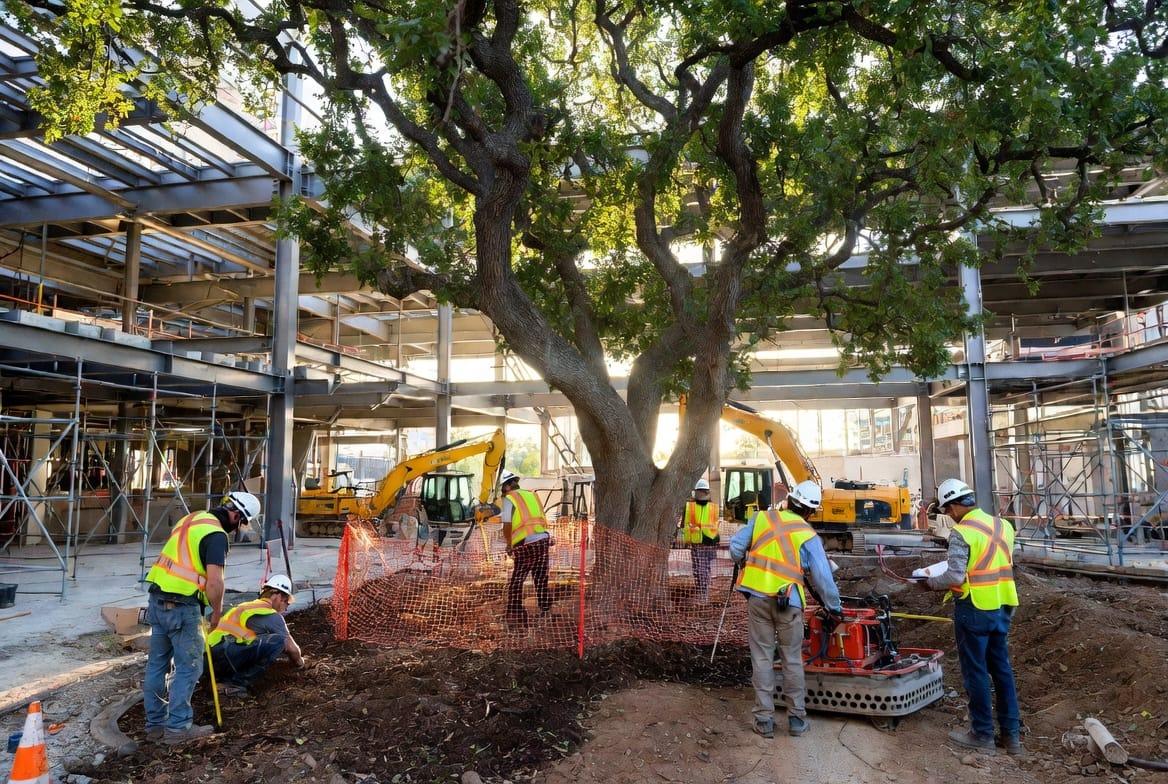
On a ravine property, the route to the tree can be as important as the tree itself. A crew may need to work from a narrow side yard, a terrace, the upper edge of a slope, or a lower garden with limited entry. Each route creates different questions: where can people stand safely, where can equipment be positioned, how will cut sections be controlled, and where can brush and wood be handled without crossing a sensitive area? A careful site plan maps these details before the crew arrives.
Sloping ground requires attention to footing and the direction in which material can be lowered or moved. A removal plan should account for the tree’s lean and crown, nearby structures, retained trees, fencing, the slope’s shape and the available work area. Depending on the tree and site, arborists may dismantle it in sections and control pieces with ropes rather than fell the whole tree at once. The correct method is site-specific; no single technique suits every ravine property. Ask the company to explain how it intends to manage the tree and debris around the slope, and to identify any limitations that could change the approach.
Protecting the ground matters because the roots and soil around a ravine can be vulnerable to compaction, rutting, scraping, excavation or uncontrolled water flow. Toronto’s permit guidance treats ground disturbance, storage, vehicle movement over roots and discharge across a slope as activities that can harm trees or protected land. Tell the estimator about soft ground, drainage paths, retaining structures, exposed roots, recent grading and places where water naturally runs. The removal plan should keep traffic, staging and debris handling to the permitted and necessary work area.
Do not create a new route by cutting through shrubs, stripping vegetation, moving soil, widening a path or dumping wood chips on a slope without confirming that the work is allowed. Those actions may affect roots, grade or ravine vegetation and can raise separate permit questions. Keep debris from blocking a swale or drainage path, and do not direct runoff down a steep face. If the City requires a geotechnical report or drainage and slope-stability details for a broader ravine proposal, those are technical documents for appropriately qualified professionals; a tree crew’s removal quote is not a substitute.
When reviewing a work plan, ask where the crew will stand, how material will be lowered, where equipment will remain, and how brush and logs will be taken away. Clarify how the ground will be checked after work and what happens if the crew discovers a previously unseen obstruction. The aim is to preserve the slope and the vegetation that is meant to stay while safely completing only the work authorized. In a difficult setting, moving slowly through these questions is part of good tree removal ravine property Toronto planning.
What the City’s application may involve
The paperwork varies with the kind of permit and the site. The City’s ravine application guidance lists items that can include a plan of survey showing the regulated ravine area, scaled site plans and grades, an arborist report, landscape or forest-restoration information, grading plans, and other technical material where relevant. For construction activity, the City says its arborist-report information covers trees on the site and on adjacent properties within 12 metres of construction activity. These are application requirements, not a universal checklist for every homeowner seeking to remove one tree.
Ask the City which forms and supporting materials apply to your proposed activity. Confirm the regulated-area line, tree ownership and the scope of work before assembling the package. If the project is connected with site-plan approval or a building permit, the City says the ravine permit may be reviewed with that process, and the permit is issued subject to the applicable approvals. Keep the tree removal separate from any other work until the required authorization is issued. The City’s guidance says the application itself is not a guarantee of approval and the permit must be issued before permitted activities begin.
Homeowners sometimes assume a permit applies only to the trunk being removed. But the City's protected-area rules can also be relevant to access, ground changes, staging, fill, refuse, structures and the health of retained trees. Identify the actual work footprint, not only the stump. If the crew needs to cross or work beside protected vegetation, make sure that access plan has been included in any required submission or permit conditions. Check the City’s latest tree and ravine permit guidance and application instructions, then confirm your own situation directly with the City.
Questions to ask a tree removal company
Use a site visit to learn how the provider understands the job, not only what the estimate includes. A company should be able to discuss the tree, constraints, access, protection needs and the written scope in terms you can follow. These questions help compare proposals without assuming every ravine job uses the same method:
| Planning topic | What to confirm | Why it matters |
|---|---|---|
| Tree and work scope | Which tree, branches, stump or ground tasks are included? | Prevents confusion about what is authorized and contracted. |
| Permit status | Which City approvals and conditions apply before work? | A quote or pending application is not a permit. |
| Access and staging | Where will crew members, equipment and material travel? | Helps protect slopes, retained trees and neighbouring property. |
| Debris handling | What will be removed, left on site or cut into sections? | Sets a clear cleanup expectation before the visit. |
| Site protection | How will the crew protect roots, soil, drainage and structures? | Ravine work can involve sensitive ground beyond the trunk. |
- What do you understand the work to include, and which tree or trees are in scope?
- What access route and equipment area are you proposing to use?
- How will the crew manage the slope, nearby structures and trees that are staying?
- What permits, approvals or owner consents need to be confirmed before work starts?
- What should I move or mark, and what areas should remain off-limits?
- Does the written scope include brush, trunk wood, stump work and final cleanup, or are any items separate?
- Who should I contact if site conditions differ from the estimate?
- What relevant insurance and qualifications can you provide for review?
Ask the company to put the agreed scope in writing. Compare what each quote says about tree removal, cutting and handling wood, hauling material, cleanup, access, stump grinding and any follow-up. If you need stump grinding, confirm whether it is included, optional or a separate visit. If only pruning is required, compare with Toronto tree trimming and pruning before choosing full removal. A comparison of an arborist and a tree service can also help you understand which professional role matches the question you need answered.
For a larger clearing project, the planning and approvals may differ from a single-tree job. See the service information for lot clearing across the GTA, and ask the City whether additional ravine or planning requirements apply. Bosco Tree serves the Toronto and GTA market, with services that include tree removal, pruning, stump work, emergency tree service and arborist reports. A conversation about your property can identify what must be confirmed before work is considered.
How to plan tree removal on a ravine property
Work through these steps before you choose a date. Each one helps separate what the owner can prepare from what the City and qualified professionals must confirm.
- Locate the regulated area. Check the City’s Ravine and Natural Feature Protection map and ask the City about an unclear boundary.
- Confirm tree ownership. Use a current survey or seek City guidance if the tree sits near a lot line or another owner’s land.
- Describe the full work. Include removal, pruning, stump work, access, equipment staging and any ground changes.
- Ask which documents apply. Confirm the required permit, arborist report, plans and supporting materials for this proposal.
- Wait for authorization. Read the issued permit and its conditions before any regulated activity begins.
- Review site protection. Agree on the allowed route, retained vegetation, debris handling and restoration needs with the crew.
Simple planning checklist for a ravine property
- Check the map. Ask the City to confirm a close or uncertain protected-area boundary.
- Settle ownership. Confirm the tree’s owner and obtain permission for access onto another property.
- Define the work. Include access, staging, removal, debris, stump work and any grade changes.
- Ask about documents. Confirm which permits, arborist reports and plans the City requires.
- Wait for the permit. Read the written authorization and its conditions before scheduling regulated work.
- Plan protection. Agree how the crew will protect slopes, retained trees and drainage routes.
- Mark site limits. Identify sensitive ground, boundaries and vegetation that must remain.
- Confirm cleanup. Clarify wood, brush, stump treatment and restoration in the written scope.
Where removal is proposed because a tree appears hazardous, describe the observable concern without climbing, cutting or approaching unstable limbs. An emergency concern may require prompt professional attention, but it does not automatically erase every City, ownership or site-safety requirement. Contact the appropriate City office or 311 to confirm requirements and ask the tree service how it will manage immediate risks while keeping the public and property occupants away from danger.
When to call a professional
Get a site-specific assessment when a tree is unstable, access is steep or confined, nearby trees must remain, or a permit condition affects the work plan. Bosco Tree provides Toronto tree removal and can discuss a free quote through its contact page. The City, not the contractor, confirms permit requirements and decisions.
How Bosco Tree can plan ravine-property work
Every property has its own access, slope and protection considerations. Bosco Tree’s process starts with learning what you want done, reviewing the tree and the surrounding site, and identifying practical questions that need to be resolved before a work date. The company provides tree removal, pruning, stump grinding, arborist reports and emergency tree service; its arborists are ISA-certified, and the business has 18 years of experience, is fully insured with $2 million liability coverage, and offers free quotes. These business credentials do not replace a City permit or guarantee its outcome.
For a ravine job, explain whether you have checked the City map, whether you have a survey, and whether an application or written permit has been issued. Share the permit conditions and any approved plan with the estimator so the proposed work can be discussed against the actual authorization. If the permit is still under review, be clear about that. The crew should not treat an application receipt as permission to begin regulated activity.
During the assessment, identify the desired outcome and the constraints that matter to you: keeping a particular tree, avoiding a garden, preserving a fence, leaving wood in a specific place, or taking all debris away. The arborist can discuss options, access, methods and scope. If the best course is pruning rather than removal, the company can explain what its tree pruning and trimming service involves. If the tree presents a concern, a separate arborist report service can help document condition and recommendations.
Get the agreed tasks in writing, including what happens to brush, logs, the stump and the immediate work area. Ask which items are not included, how the crew expects to reach the tree, what protection is planned for retained vegetation, and which City conditions you need to observe. The company can help you understand the tree-work scope; decisions about regulatory boundaries and permits remain with the City. For help with next steps, contact Bosco Tree through its contact page or review the company’s Toronto tree-care information.
After the tree is removed
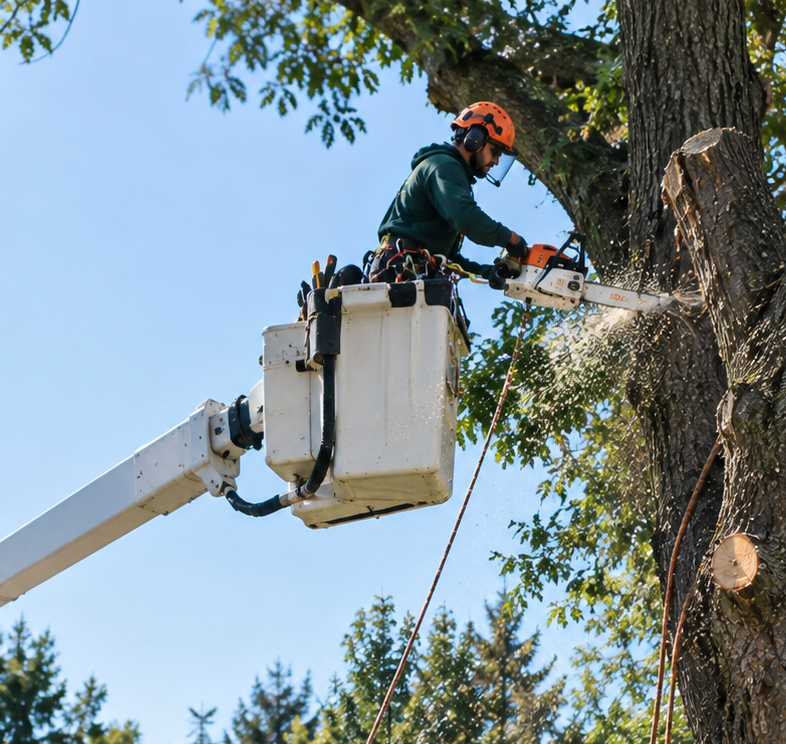
Removal is only one part of the property’s next chapter. Check the work against the agreed scope and any permit conditions, including stump handling, debris removal, protection of retained vegetation and required replacement planting. If the permit calls for restoration or other follow-up, keep records and follow the City’s instructions. Do not alter the grade, add fill, place refuse or direct water onto a protected slope as a casual cleanup measure; those activities may have their own restrictions.
Ask whether the stump will remain, be ground down, or be addressed in a separate visit. In a ravine setting, stump and root work can affect soil and nearby vegetation, so get the method and approval requirements confirmed before disturbing the ground. If replacement planting or naturalization is a condition, follow the approved plan and ask the City what documentation or inspection is required. Plant selection and placement should suit the location and the approved conditions rather than being improvised immediately after removal.
Walk the site with the crew lead when the work is complete, from a safe distance and only after the crew says the work area is clear. Confirm that the expected wood and brush have been handled, identify any remaining debris or surface issues, and ask what follow-up is part of the agreement. Keep photographs of the completed work and copies of the estimate, permit and any relevant reports. If a problem arises, contact the company promptly and describe it clearly with photographs.
For owners planning additional tree work, the timing and scope of one removal can affect decisions about nearby trees. Consider whether a remaining tree needs an assessment or maintenance, whether a new planting is required, and whether future construction or yard changes will affect the protected area. Bosco Tree’s guides on dead tree removal, tree trimming in Toronto and winter tree care provide related homeowner information. A second project should be evaluated on its own permit and site requirements.
Frequently asked questions
Does every tree on a ravine property need a permit for removal?
The City says trees of any size in a protected ravine or natural feature area cannot be harmed or removed without authorization under Chapter 658. Whether a particular tree and activity are inside the regulated area must be confirmed for the property. Contact the City before arranging work.
Does Chapter 813 protect a small private tree?
The City’s guidance says Chapter 813 generally protects private trees measuring 30 centimetres or more in diameter, while street trees are protected at any size. A smaller tree inside a protected ravine area may still be covered by Chapter 658. Ask the City to confirm which rules apply.
How can I tell whether my property is in a protected ravine area?
Use the City’s Ravine and Natural Feature Protection map and search the address, then review the protected-area boundary layer. If the line is unclear or close to the proposed work, ask the City for clarification and consult a current survey. An address near a ravine does not by itself settle the regulated boundary.
Will an arborist report guarantee a removal permit?
No. An arborist report supplies professional information for an application, but the City reviews the proposal and decides whether to authorize it. The City also states that submitting an application does not guarantee a permit. Confirm the required documents and wait for authorization before work begins.
What does an arborist report cover for a ravine application?
A ravine application may need tree locations, species, size, condition and health, plus protection or pruning details relevant to the work. For construction, the City guidance refers to trees on the site and neighbouring properties within 12 metres of construction activity. Confirm the exact submission with the City.
Can a tree company decide that the ravine permit is not needed?
A tree company can assess the site and explain its proposed work, but the City is the authority on its by-laws and permit decisions. Do not treat an estimate or contractor opinion as a formal permit determination. Contact Toronto Urban Forestry or 311 if the requirement is uncertain.
Can a crew use a neighbour’s property to reach the tree?
Not without appropriate permission. The City explains that a permit does not determine ownership or authorize entry onto another person’s private property. Agree on access with the neighbour and resolve ownership or boundary questions before work is scheduled.
Can removal proceed while the application is being reviewed?
Do not begin work that requires authorization while the application is pending. The City says a submitted application does not guarantee a permit and that required permits must be issued before the permitted activity starts. Confirm any urgent safety situation and applicable exception directly with the City.
What should I ask about cleanup after ravine tree removal?
Ask whether brush and trunk wood will be hauled away, whether any material will remain, whether the stump is included, and how the immediate work area will be left. In a protected area, also confirm that ground disturbance, restoration and any replacement planting follow the City’s conditions. Put the scope in writing before work begins.

Lot Clearing for Builders GTA | Bosco Tree
A practical GTA lot-clearing guide for builders and homeowners covering arborist review, permits, retained trees, TPZs and site coordination.

Tree removal for home addition Toronto | Bosco Tree
Plan tree assessment, Toronto permits, protection for retained trees, authorized removal and site preparation alongside your home addition.

Arborist vs Tree Service Toronto | Bosco Tree
Learn when to call an arborist, a tree service or both in Toronto, and what to ask before booking tree care.
Tree Protection Zone Toronto | Bosco Tree
Plan tree protection for Toronto construction with guidance on arborist reports, TPZ barriers, project steps, and City approvals.
Tree Removal Permit Toronto: Do You Need One?
Learn when Toronto tree rules may apply, what an arborist report can do and how to confirm current permit requirements before work starts.